How to Say No at Work: A Framework for Managers Managing Competing Priorities
Saying yes to everything can feel like the only way to be “successful”. It may even align with feeling helpful. But, it's a fast track to burnout and resentment. Both yours and your team's.
The problem could be that you're asked to do too much. But it’s likely aided because you lack a strategic framework for deciding which requests align with the goals and which ones you need to decline professionally.
I want to take you through a 5-step decision making system that helps you set boundaries, manage competing priorities, and give your team permission to do the same. You'll practice saying no without guilt, communicating shifting expectations clearly, and getting to complete the work that matters most.
Step 1: Align Your Decision With Your Goals, A Decision Matrix
We start with where you’re at. Right now, how do you make decisions about requests that come your way? What’s working about that method and what needs to change? Once you’ve identified the weaknesses you’re working with,see if any of these steps could support your decision making further.
Ask yourself
Does this advance my group's research, development, or the organizational mission? (Goal alignment)
How much time will it realistically take? (Time cost)
Try out mapping requests onto this 2x2 matrix:
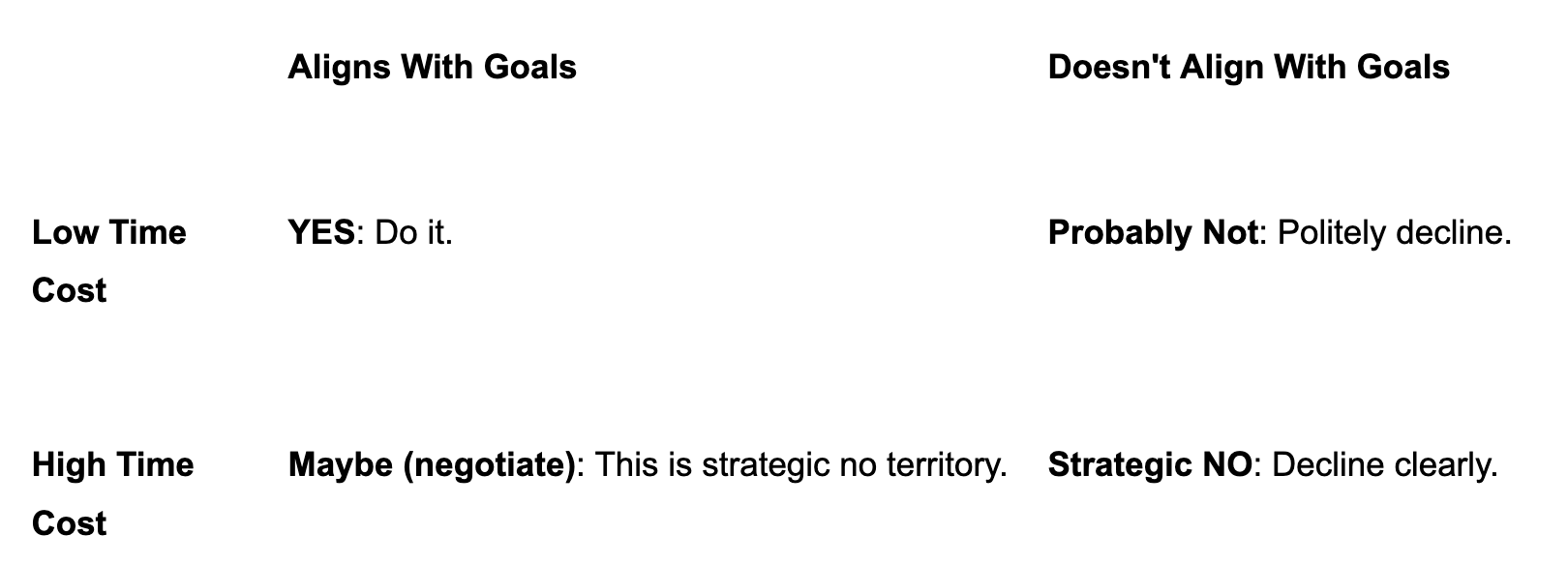
Aligns with goals | doesn’t align with goals are on the top axis. the Long axis up and down is low time cost and high time cost.
What this does for you: It removes emotions or feelings from the decision. Saying no isn’t about the person making the request. You're saying no because it doesn't serve the current mission or it costs too much relative to your capacity.
Bonus: When you model this framework with your team, you give them permission to use it, too. Managers who help their staff think strategically about requests, rather than automatically saying yes, build more resilient, intentional teams. If you have a manager working through a decision, model the matrix process with one of your own decisions, and then go through the matrix process together with their decision.
Step 2: List All Your Deadlines in One Place
It’s awfully hard to manage what you don't see. The moment a request lands on your desk, it needs to join the deadlines list/calendar.
Write down everything:
Papers and reports
Presentations and symposiums
Conference talks
Group meetings (recurring and one-time)
Important deadlines
Project due dates
Reviews and evaluations
Projects and initiatives
Teambuilding events or relationship-building commitments
Anything else with a due date, even if it's self-imposed
Why in one place? Because competing priorities feel chaotic when they're scattered across your calendar, email, and sticky notes. One list shows you the real landscape of your commitments. This is where you can actually see if you're overcommitted.
Step 3: Map Dependencies, Who Needs What From You
Not all deadlines are created equal. Some only affect you. Others ripple across your team or organization.
Ask:
Which deadlines are just for me? (e.g., Your board presentation, your professional development, or your donor relationship-building)
Which ones require my team's input or output? (e.g., A grant report where program staff provide data, a fundraising event where staff volunteers, or a program evaluation)
Which ones depend on others? (e.g., You can't submit the grant report until your program director sends evaluation data or you can't finalize donor ask amounts until development staff completes prospect research)
Why map this: When you see dependencies, you realize you can't work in isolation. You need to start conversations now with the people who can help or who need to know your timeline. This prevents bottlenecks and keeps surprises out of your deadlines.
Step 4: Add Buffer Time, Assume 20% More Time Than You Think
Here's what happens: You estimate 10 hours for a task. It takes 12. You build in a small meeting buffer for your team. It runs 15 minutes over. You underestimate how long revisions take.
Add 20% to everything. Then add another 30–60 minutes of "buffer time" that week designated for that specific project.
A practical example:
You have a major grant report due in 6 weeks and estimate it needs 60 hours of work (including collecting data from program staff, writing, revisions, compliance review):
60 hours + 20% = 72 hours
Spread 72 hours across weeks 1–5 (not week 6—that's for final edits and emergencies)
Block time backward from your deadline on your calendar
Add 90 minutes of buffer time in weeks 3 and 5 for unexpected revisions or staff delays
Reserve week 6 for final compliance review and submission
Why backward timeline? Because deadlines sneak up on you if you work forward. When you start at the due date and work backward, you see exactly when you need to start and whether that's realistic given your other commitments.
Step 5: Communicate What's Changing, and Then Say No Strategically
Once you've mapped everything, you need to tell people what they can expect from you. This prevents resentment and miscommunication.
Have proactive conversations with:
Your supervisor (about your workload and priorities)
Your team (about what you're focusing on and when you'll be available)
Your colleagues and collaborators (about timelines and dependencies)
The message:"Here's what I'm working on this quarter. Here's the sequence and why. Here's when I'll need your input. Here's what I'm not taking on right now, and here's why."
Then, when a new request arrives, you have context. You can use one of three professional ways to say no:
Data-Driven No
Use this when someone needs to understand the real cost.
"I want to be honest with you. I currently have [X, Y, Z] on my plate. Adding this would mean [specific consequence—missing a deadline, lower quality work, delayed deliverables]. I can't do that responsibly. Here's what I can do instead…"
This works because it stays focused on the facts. You're protecting quality and reliability, not rejecting the person or the request.
Deadline Reset
Use this when the work matters but the timeline doesn't.
"This matters, and I want to do it well. Given my current capacity, I could start this on [realistic date]. Is that timeline workable?"
This shows you're willing but honest. It shifts the conversation from Can you do this? to When can you do this well?
Delegation or Redirect
Use this when someone else is better positioned to help.
"I'm not the best person for this. Have you considered [person/resource]? I'd be happy to make an introduction."
This keeps the work moving without burdening you, and it often develops your team's capabilities.
Bring It Together: A Real Nonprofit Scenario
Let's walk through how this works in practice at a nonprofit organization.
Your situation: You're the Director of Programs at a mid-sized nonprofit. It's October. You have:
A major grant report due in 6 weeks (for Foundation XYZ, covers 40% of your operating budget)
Your organization's largest annual fundraising gala happening in 8 weeks (raises 20% of annual revenue)
Staff performance reviews due in 4 weeks
A program evaluation that's overdue and needs to be completed before the grant report
Your usual weekly leadership team meetings and one-on-ones with your 5 direct reports
A board meeting in 3 weeks where you're presenting year-end program outcomes
Your executive director just asked you to lead a new community partnership initiative with another local nonprofit. It's a great opportunity for mission expansion. It would take 5–8 hours per week for the next 12 weeks. New request landed.
Step 1 (Alignment Matrix): Does leading this partnership advance your mission? Absolutely. Iit expands your reach and impact. How much time? Five to eight hours per week indefinitely. High time cost + mission alignment = Maybe/Strategic No territory. This calls for negotiation, not automatic acceptance.
Step 2–3 (Your deadlines + dependencies): You map everything and realize:
The grant report depends on your program staff submitting evaluation data by Week 3
The gala depends on your development director's vendor contracts being finalized by Week 4
Your board presentation needs final program outcome numbers from the evaluation
Staff reviews can't happen until after the gala (you'll be in crisis mode that week)
Step 4 (Buffer time): You work backward. The grant report is due Week 6. You need to start writing by Week 2 to allow time for revisions and compliance review. That means you need program data by the end of Week 1. You block 12 hours per week for weeks 1–4 on the grant work. You add 90 minutes buffer time in Week 3 (when staff often miss deadlines) and Week 4 (for revisions). The gala week is blocked as "gala execution only," which means no grant writing. Staff reviews get pushed to late November after the gala.
Step 5 (Communicate & say no):
You tell your executive director:"I'm excited about this partnership because it's exactly the kind of expansion we need. But I have three major deadlines converging this quarter: the Foundation XYZ grant, our annual gala, and program evaluations. If I take this on now, something will suffer—likely the grant quality or my team's morale during the gala. I can lead this partnership starting in January. Could we frame it as a Q1 initiative? I can do preliminary relationship-building with the partner in December without the full time commitment." (Deadline Reset + Data-Driven No)
You tell your program staff: "I need your evaluation data by October 22 so I can incorporate it into the grant report. I know you're also supporting gala logistics. Here's my commitment to you: I'm protecting your time on both. I'm not asking you to do event setup after 5 PM or on weekends. In exchange, I need the data on time so we don't miss the grant deadline." (Clarify dependency + show you're managing the load)
You tell your development director: "The gala is our joint priority through mid-November. Everything else gets pushed back. When we're in that execution phase, I'm available to problem-solve and support, but I won't be able to take on new initiatives." (Communicate availability)
You tell the board (via your ED): "This quarter we're focused on grant compliance, our signature fundraising event, and program evaluation. Staff reviews and strategic planning will happen in Q4 and Q1. This protects our funding and gives us the data we need for next year's planning." (Set expectations proactively)
Result: You complete the grant on time and with quality. The gala is successful. Your team knows what to expect and feels protected. Your Executive Director understands why you said no and appreciates the framework. And when the partnership conversation comes back up in January, you have actual capacity to lead it well.
Start using this framework to map your own deadlines, dependencies, and buffer time in ways that support you and your team best.
Take This Deeper
Want to learn how to ask better questions instead of directing your team? Read the post on Question-Based Supervision: Moving From Telling to Askingto help your staff develop this same strategic thinking when they're managing competing priorities in their own roles.